

On the afternoon of April 17, the sixth session of the Spark Salon was held at Lishen Xuan (2nd Floor). The event was jointly organized by the International Office of BNU Zhuhai and the Faculty of Arts and Sciences.
The session invited Prof. John Kelvin Webb, a renowned astrophysicist and professor in the Department of Physics, to deliver a talk titled "Does the Universe Make Sense?" Drawing on his long-term research in quasar spectroscopy and cosmology, Prof. Webb took the audience on an intellectual journey from philosophical reflection to astronomical observations.
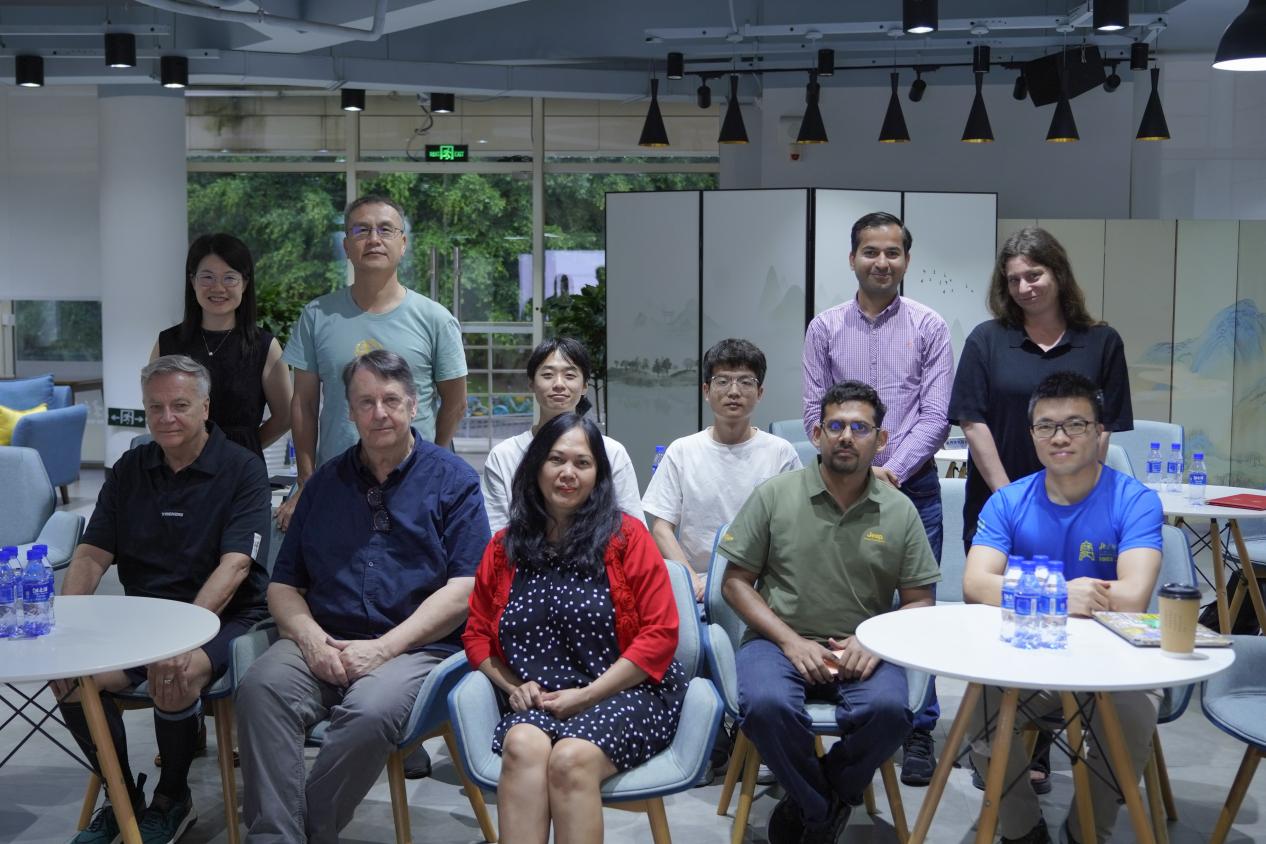
At the beginning of the salon, Prof. Webb quoted Einstein's famous remark: "The most incomprehensible thing about the universe is that it is comprehensible." Yet he proposed a very cautious stance — that the universe may be only "partially comprehensible." Using the triple-alpha process and the strength of electromagnetism as examples, he explained that if the energy level of beryllium-8 (on which carbon synthesis depends) were slightly different, or if the electromagnetic force changed by about 4%, life would never have emerged. Why do these constants fall so precisely within the "habitable" range? Prof. Webb described this as one of the deepest mysteries in physics.
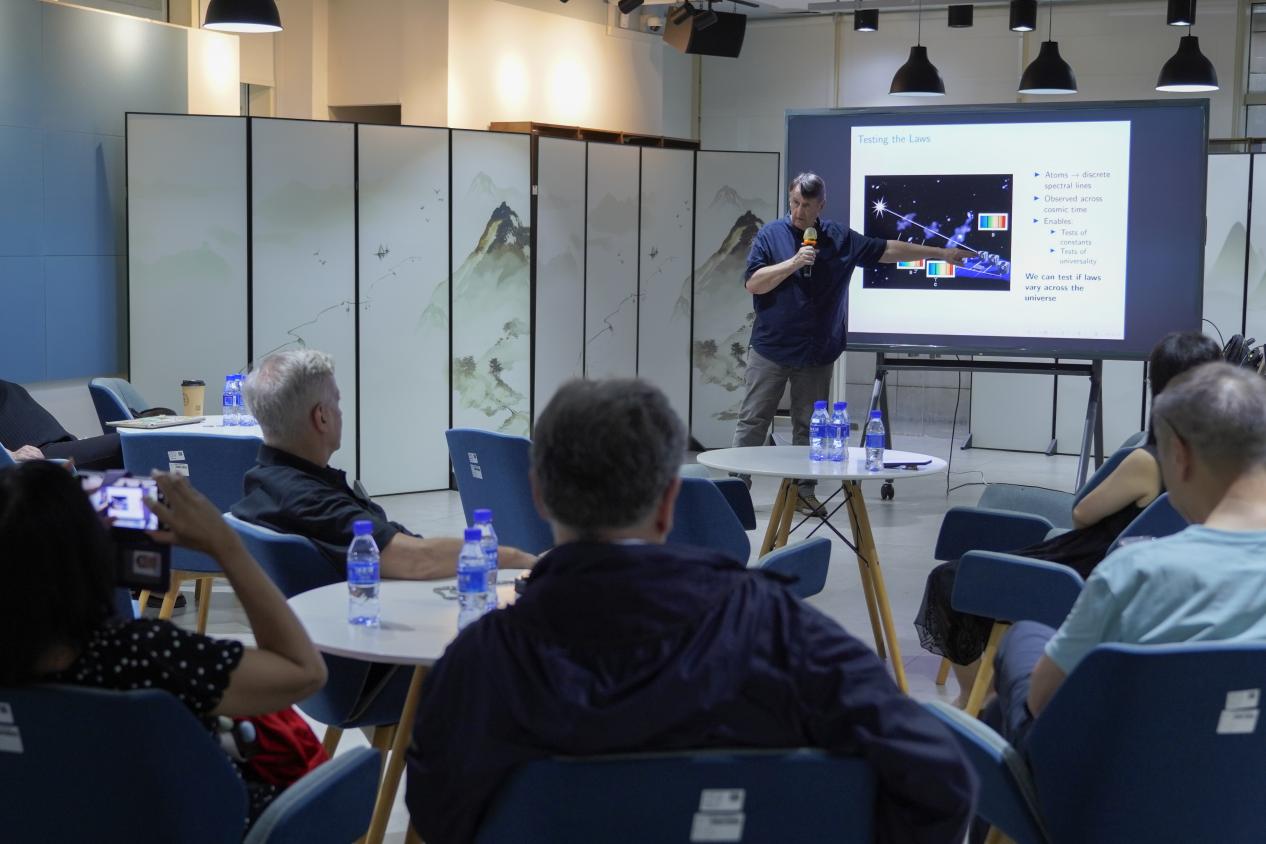
Prof. Webb then introduced the "no-hair theorem" of black holes as an example of complexity reduced to simplicity. But are the laws of physics the same everywhere? His team uses quasar absorption lines to test whether the fine-structure constant (which measures the strength of electromagnetism) varies. Observational data suggest a possible spatial anisotropy of about one part in a million on scales of billions of light years—a dipole structure. If confirmed, this would challenge the Einstein equivalence principle and the cosmological principle, implying that here on Earth, we might be governed only by "local bylaws" of physics.
During the Q&A session, Prof. Webb noted that science and philosophy were once closely connected in the era of natural philosophy, and that their separation today may have slowed major breakthroughs. He agreed that philosophy, science, and even the arts should learn from one another, with curiosity and inquiry as their common starting point.
As a regular academic exchange event at BNU Zhuhai, the Spark Salon aims to provide an open and relaxed platform for educators from diverse cultural and disciplinary backgrounds to break down barriers and spark innovative thinking. Prof. Webb's talk not only deepened the audience's understanding of the fundamental laws of the universe but also demonstrated how philosophical questions can be integrated with empirical science, opening a new perspective on the nature of physical laws.